Letterboxd is a social film diary you open after the credits roll. Limelight is a private tracking and discovery tool you open before you've picked anything. Every title shows where it's streaming, and Limelight+ adds ratings from four sites. Letterboxd and Limelight get compared a lot, and I understand why. Two apps for people who care about movies, both dark-themed, both with loyal users who will tell you about them unprompted. I built Limelight, so I'm biased, but I've also spent more time than anyone thinking about where these two apps overlap and where they don't.
The short version: they barely compete. Letterboxd is what you open after the credits roll. Limelight is what you open before you've picked anything. I built Limelight because the "which of my six streaming subscriptions has the movie I want to watch tonight" problem was not solved, and Letterboxd was never trying to solve it. That's the frame for this comparison, and everything below flows from it.
If you're trying to figure out which one to use, the short answer is that they're barely competitors. They look similar from a distance, and up close they solve completely different problems. Here's the actual difference.
What is Letterboxd built for?
If you are weighing more than these two, the wider list of Letterboxd alternatives covers the rest. Letterboxd is a social film diary. The core loop: you watch a movie, log it, write a short review or a one-liner, and see what the people you follow thought of the same film. Everything in the app bends toward that loop, and the community is the reason it works.
The Letterboxd community is one of the best on the internet. Sharp, film-literate, occasionally insufferable in a way that's endearing if you're in on the joke. People genuinely discover directors there by reading a four-line review from a stranger in Portugal. That kind of discovery is real, and it's almost entirely driven by the social layer, which has accrued over more than a decade and is not replicable by any amount of product work.
If you want film to feel like a shared experience, Letterboxd does that better than anything else. Not IMDb, not Rotten Tomatoes, not any streaming service's built-in review feature.
What doesn't Letterboxd do?
That's the pitch. Here's the list of things Letterboxd is not built for:
- TV shows. Letterboxd's App Store listing still doesn't include TV tracking as of September 2026. If you watch prestige television, and at this point most film fans do, half your viewing is invisible to the app.
- Multi-source ratings. No Rotten Tomatoes number, no IMDb score, no Metacritic aggregate. You get the Letterboxd community rating, which is charming but skewed heavily toward specific film-school sensibilities.
- Scene recognition. If you see a frame on Instagram or TikTok and want to know what it's from, you're copy-pasting into Google.
None of these are bugs. Letterboxd picked a lane, stayed in it, and built the best version of that lane that exists. The product has a point of view, and the point of view is "we are a diary for people who love talking about movies."
That wasn't the problem I was trying to solve.
What is Limelight built for?
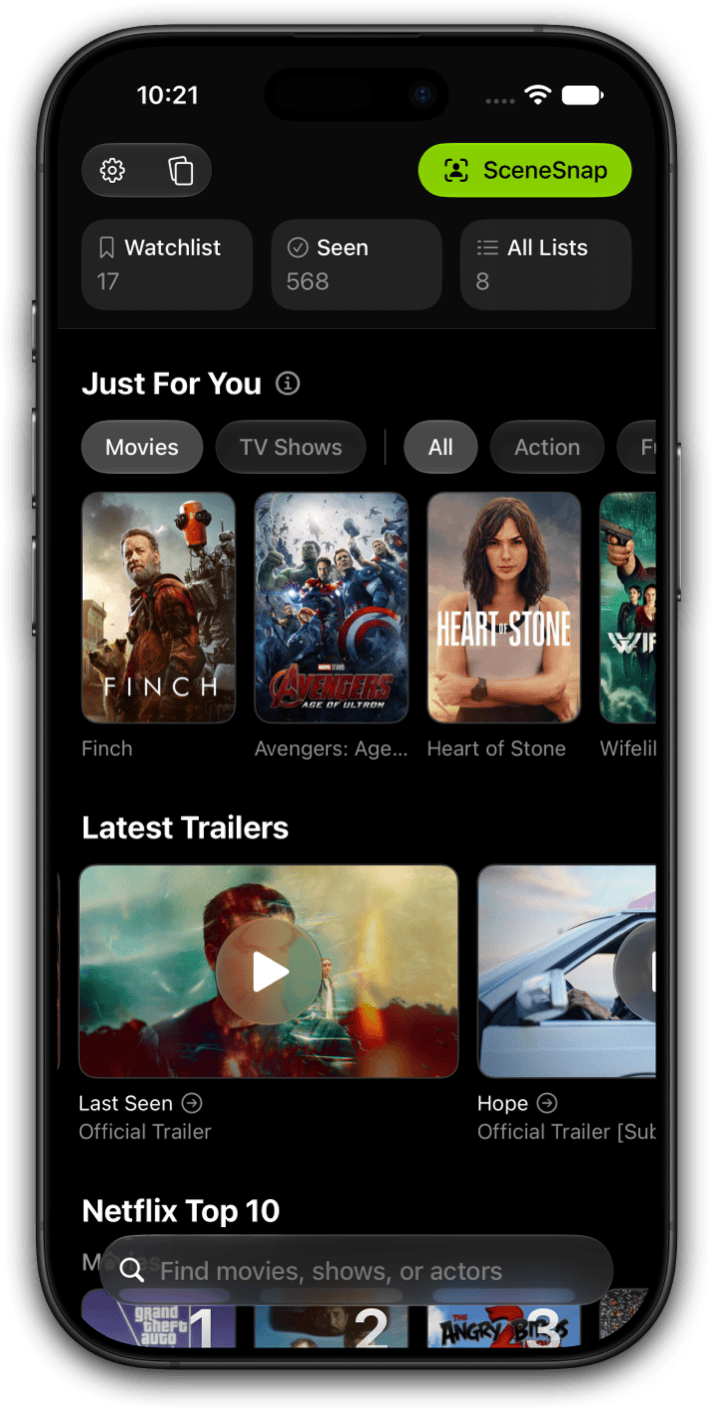
Limelight is a private tracking and discovery tool. No profiles, no followers, no public reviews. Your Watchlist is yours, your Seen List is yours, and the app never shows you what other people thought.
The loop is also different. In Letterboxd, the loop starts after the credits roll. In Limelight, it starts before you've picked anything. Search for a title and you see its ratings from Rotten Tomatoes, IMDb, Metacritic, and TMDB on a single screen. You see exactly which streaming services carry it right now. You add it to the Watchlist, and when you actually sit down to watch something, QuickSort can order that list by which services it currently streams on.
Limelight is what you open when you want to watch something. Letterboxd is what you open after you've watched it.
I built it because I kept doing the same thing every night. Open Netflix and scroll, open Prime Video and scroll, open HBO Max and scroll, give up, rewatch an episode of The Office I'd already seen three times. My watchlist existed in my head and in a notes app, and neither place told me which streaming service carried which title. Fifty dollars a month on subscriptions and I was defaulting back to sitcoms.

Limelight covers movies and TV shows equally. The same features work the same way for a 1974 Tarkovsky film as for a new HBO miniseries. It also includes SceneSnap, an AI feature that identifies any title from a short video clip. Useful for the specific moment when a scene is playing and nobody in the room can name it.
Try the decision layer for yourself
Limelight is free on iPhone, iPad, and Mac. Search any title, see every streaming service it's on, and build a Watchlist that works across all of them. No social feed, no ads.

Why can't a film diary fix the watchlist problem?
The Letterboxd watchlist is a fine place to dump titles, though it is not a watchlist system. A friend mentions a movie, you tap "Watchlist," it lives there. A week later, when you open the app with 90 minutes to kill, the watchlist is not helpful for making a decision. It's a list of 180 titles with no indication of which ones you can actually stream tonight without paying $5.99 to rent.
That's not a flaw. It's a scope choice, and there's something respectable about a product that refuses to expand past its core job.
But streaming data was the thing I needed, and the research backs up why. A 2025 Nielsen study found that 51 percent of U.S. streamers say it's harder to find something to watch than it was two years ago. Almost half have canceled a service specifically because they couldn't find anything on it. Think about that. People are paying real money every month and quitting because the product is too full.
A film diary doesn't close that distance. A tool that tells you where to watch any movie does. Those are different jobs, and they benefit from being done by different apps.
Where does Limelight fall short of Letterboxd?
If you've read this far and think I'm setting up a Limelight infomercial, this is the part where I owe you a straight answer. Letterboxd does several things Limelight does not do, and in some cases should not try to do.
The obvious one is community. Letterboxd has more than fifteen years of accumulated social graph, cultural inside jokes, four-line reviews that read like poetry, and director Q&As that happen organically in the comments. I cannot build that on a timeline, and I do not want to. A discovery tool with a comment section turns into Twitter within six months, and nobody needs more of that.
The second is list curation as performance. Letterboxd lists are a legitimate art form. People build themed lists around "films where a character writes a letter they never send" or "movies set entirely in a parking lot," and the lists go viral inside the community. Limelight+ has custom lists, but they're private. That's the right tradeoff for what Limelight is, but if the reason you love film is the cultural conversation around it, Letterboxd wins this one and it's not close.
The third is recommendations from specific humans. On Letterboxd, you can follow a critic whose taste maps to yours and get a constant feed of what they've rated four stars this month. Limelight's recommendations are algorithmic and personalized to your own logged viewing. That works well if you haven't found a kindred reviewer yet, but it's not a substitute for following a person whose taste you already trust.
I built Limelight to solve the decision problem, not to replace film culture. Letterboxd is better at film culture, and any fair comparison has to say so.
How do the two apps handle ratings differently?
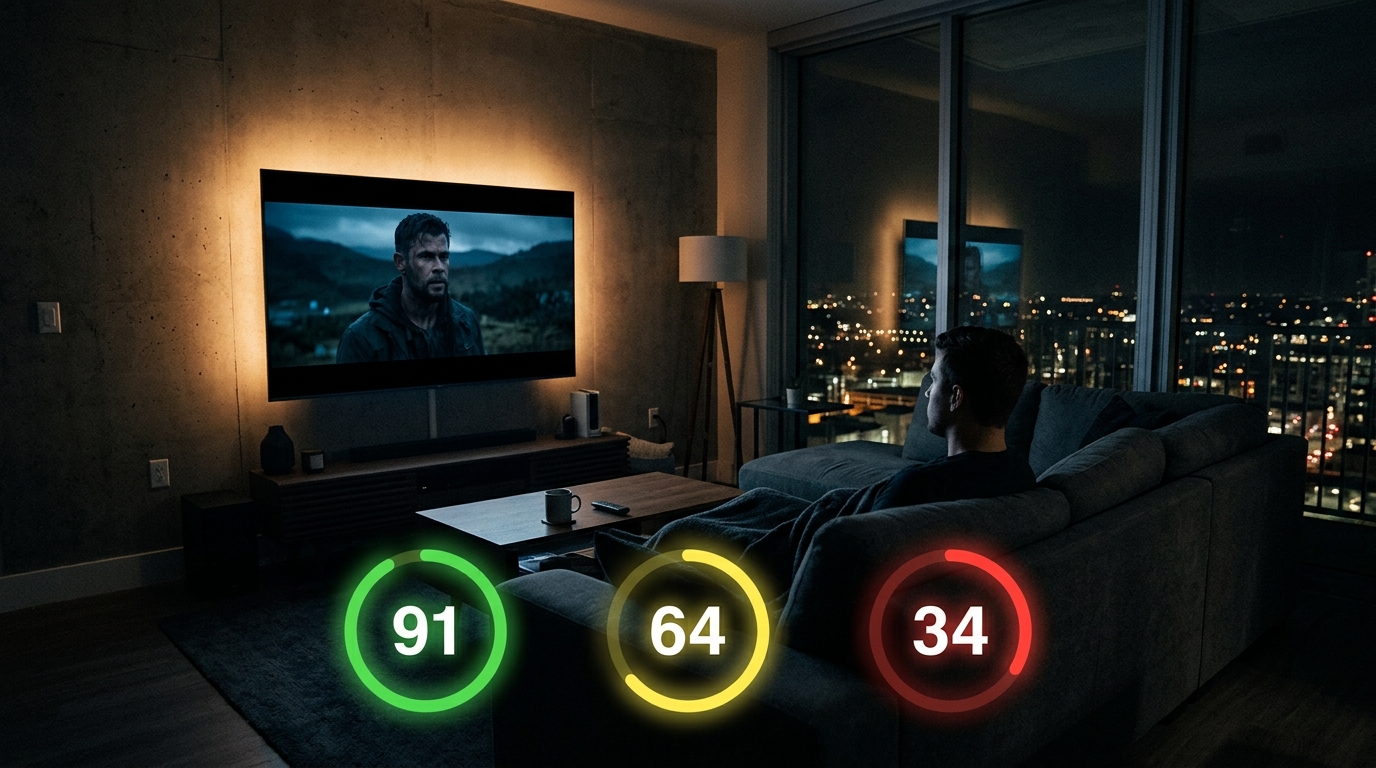
This one is worth its own section because it trips people up. Letterboxd shows you a single community score out of five stars. Limelight+ shows you four numbers side by side: Rotten Tomatoes, IMDb, Metacritic, and TMDB.
Both approaches are legitimate, and they optimize for different things. The Letterboxd score tells you what a specific, self-selected community of film enthusiasts thought. It skews toward particular sensibilities: formally adventurous work, auteur directors, the kind of film that rewards a second viewing. That is a feature if you want to be in conversation with that community. It's a bug if you're trying to predict whether a casual Tuesday-night viewer will enjoy a mainstream comedy.
Multi-source ratings solve a different problem. A movie that's 92 percent on Rotten Tomatoes, 7.1 on IMDb, and 71 on Metacritic is telling you something coherent: critics loved it, general audiences liked it, and the professional aggregate landed in "good but not great." A title that splits across sources, say 45 percent on Rotten Tomatoes but 8.2 on IMDb, is also telling you something: critics hated it, audiences loved it, now you know what kind of movie it is. That signal disappears when you collapse it into one number.
Neither system is objectively right. I built Limelight's version for people who want the signal before they commit two hours. Letterboxd's version is better for people who already know what they like and want the community temperature.
Letterboxd vs. Limelight, side by side
| Feature | Letterboxd | Limelight |
|---|---|---|
| Movie tracking | ||
| TV show tracking | ||
| Streaming availability | ||
| Multi-source ratings | ||
| AI scene recognition | ||
| Social community | ||
| Public reviews | ||
| Ad-free | ||
| iPhone and iPad app |
Which one should you use?
If you want to participate in film culture, use Letterboxd. Follow people whose taste you trust, read the short reviews, keep a diary of what you watched and what you thought. This is a legitimate way to love movies, and the app is excellent at it.
If you want to spend less time deciding and more time watching, use Limelight. Track what you've seen, find where anything streams, and compare ratings across sources before committing two hours of your life. This is also a legitimate way to love movies.
The recommendation I give when people ask me directly: try both and keep whichever one you actually open. Most people who care about film end up using Limelight for the practical side of being a person with too many subscriptions and Letterboxd for the enjoyable side of logging a film after the credits roll. The apps barely overlap in function, which is exactly why they pair well.
What does a "use both" workflow actually look like?
When people ask the "use both" question, they usually want the specifics. Here's the pattern I've seen work for the people who've told me how they run it, and it's portable to anyone with a similar subscription stack.
During the week. When you hear about a film or show, it goes into Limelight's Watchlist. No filters, no thinking, just tap and save. A friend recommends something at dinner and it's saved before the check arrives. The app remembers for you.
When it's time to watch. Open Limelight, turn on the services you already pay for, and check where each title on your Watchlist is streaming. That turns a wishlist of dozens of titles into a handful of things you can start in the next ten minutes. Pick one and watch it.
After the movie. Log it in Letterboxd if that's where you want your film memory to live. A one-line review if there's something worth saying, or a star rating if not. A year from now you can scroll your diary and remember exactly what you thought about the third act.
On weekends. Scroll Letterboxd for inspiration from the people you follow. Anything that catches your eye jumps over to Limelight's Watchlist. The loop closes.
The two apps never get in each other's way because they operate at different layers. Limelight is the decision layer. Letterboxd is the memory layer. Keeping them separate turns out to be easier than trying to find one app that does both, because every app that tries to do both ends up compromising on one side.
How much does each one cost?
Both apps have real free tiers, which is rarer than it should be in 2026.
Letterboxd Pro is $19 a year. It adds statistics, custom themes, and a few power-user features. The core diary and social experience is free.
Limelight+ is $4.99 a month, or $24.99 a year with a 7-day free trial. It adds release notifications, SceneSnap, QuickSort, streaming Top 10s, and ratings from Rotten Tomatoes, IMDb, and Metacritic. It also adds custom lists, pinned items, the option to hide titles, and alternate app icons. The free version already includes search, streaming availability, the TMDB score, Watchlist, Seen List, trailers, cast and crew details, personalized recommendations, and book adaptations. No ads, privacy focused, and Limelight runs on iPhone, iPad, and Mac.
What about Trakt, JustWatch, IMDb, and Reelgood?
Letterboxd and Limelight aren't the only options in this space, so let me place them in context.
JustWatch is the best pure streaming-availability search. If you want to know where a specific title streams, JustWatch does that well and it's free. It's not a tracking tool, not a discovery engine, and not a diary. It's a search bar, not an app you open for fun.
Trakt is a powerful tracker for people who want to log TV episode-by-episode and connect automations across Plex, Kodi, or other media servers. It's genuinely capable, but the interface is dense and the core value leans toward power users who like dashboards. Limelight is closer to "the tracker my mom would actually use."
IMDb is still the universal film database and a great reference for cast, crew, and trivia. As a decision or tracking tool in 2026, it's rough. The app is crowded with ads and aggressively pushes you toward Amazon's own streaming catalog, which is a different problem than helping you find something to watch.
Reelgood is closest in spirit to Limelight, with streaming availability and a Watchlist. It works well on the web, but the mobile app has lagged and it doesn't do multi-source ratings or treat TV as a first-class citizen the way Limelight does.
The summary: Letterboxd wins the culture lane, JustWatch wins the single-title lookup, Trakt wins the power-user dashboard, IMDb wins the database reference, and Limelight is the one I built for people who just want to decide what to watch tonight without doing homework first.
Frequently asked questions
Letterboxd is a social film diary built around community, reviews, and public lists. Limelight is a private tracking and discovery tool focused on finding what to watch, where it streams, and logging what you've already seen. Letterboxd doesn't track TV shows. Limelight has no social layer, and your lists are private by default.
Only if you want something Letterboxd doesn't do. The two apps solve different problems. Limelight is stronger at tracking and streaming availability, and Limelight+ adds ratings from Rotten Tomatoes, IMDb, Metacritic, and TMDB. Letterboxd is stronger at community, reviews, and film culture. Most serious viewers who use one end up using both.
Yes, and most people who care about film do. Limelight handles the decision layer: what to watch, where it streams, and what you've already seen. Letterboxd handles the reflection layer: what you thought, who else watched it, and what the film community is saying. The two overlap almost nowhere, which is exactly why they pair well.
Yes. Limelight has treated TV shows as a first-class citizen since launch. Letterboxd's App Store listing still doesn't include TV tracking as of September 2026. Every Limelight feature works the same for TV and film, including tracking, streaming availability, recommendations, and multi-source ratings with Limelight+.
Not directly. Letterboxd offers a CSV export of your diary and watchlist, but Limelight doesn't import that file today. If this matters to you, the pragmatic move is to keep Letterboxd as your permanent diary and use Limelight for Watchlist decisions going forward.
Limelight runs on iPhone, iPad, and Mac. A web version isn't on the near-term roadmap because the core use case, picking something to watch right before you sit down, is overwhelmingly a phone-in-hand moment. That's a deliberate choice, not a resource constraint.
No feeds, no followers, no public comment threads. I might add focused features like sharing a single list with a specific person, or sending a recommendation to a friend, because those are useful without turning the app into a social network. The moment a discovery tool starts optimizing for engagement, it stops being a tool and starts being a problem.
Independent. I'm a solo developer in Nashville. Limelight has no VC funding, no parent company, and no plans to sell user data. The business model is simple: some people upgrade to Limelight+ for $24.99 a year, and that pays for the TMDB data, the streaming metadata, and my time. No ads at any tier.
See what Limelight actually does
Track what you've watched, find where anything streams, and get ratings from every source that matters on one screen. No ads, no social feed.