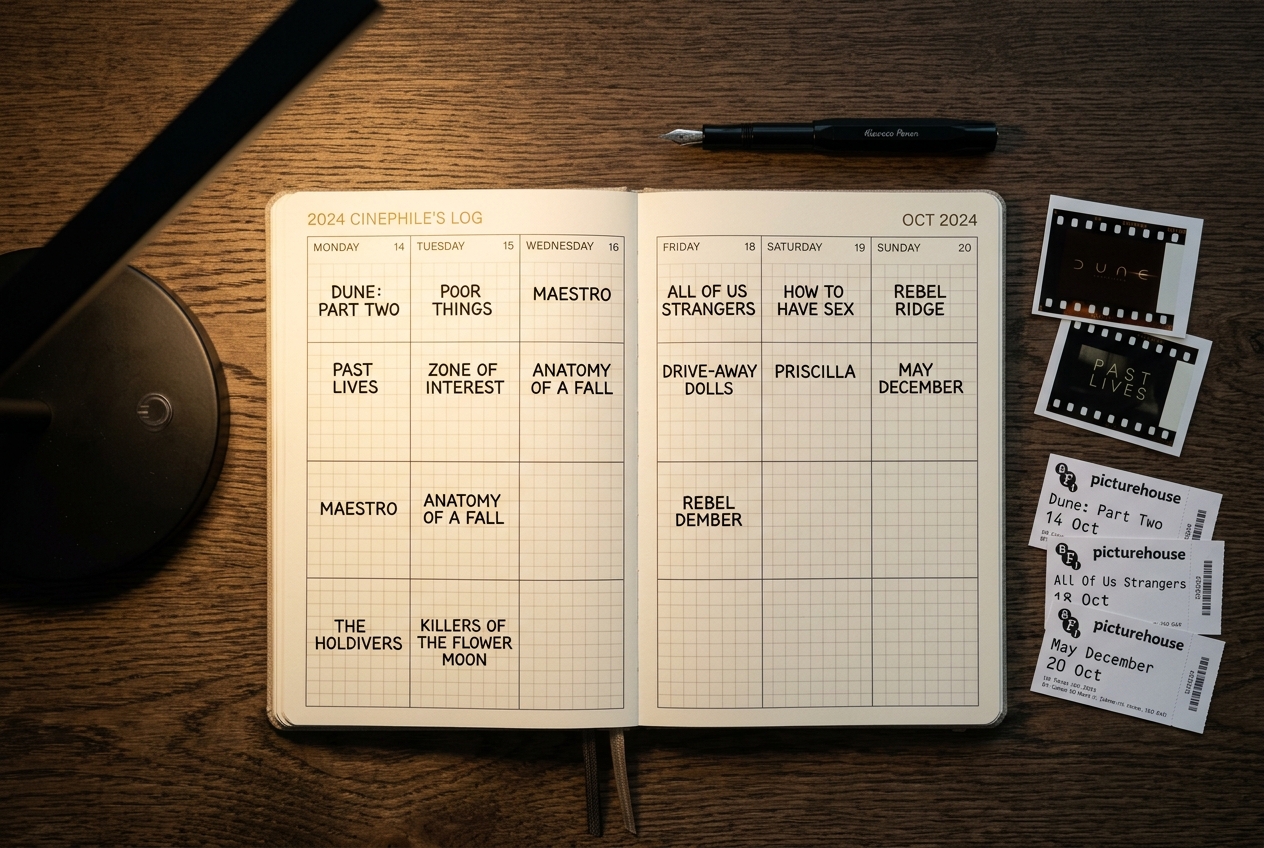
Three years ago, I started keeping a strict count of the films I watched each year. My expectation was that the number would be higher than I thought. It was lower. After the count, I also noticed something more interesting than the total: I couldn't remember most of what I'd seen. Films I watched in January were gone by July, not because they were bad, but because I'd watched them passively, without any intention, and without any structure around the watching. I was consuming films rather than watching them.
That's when I built the framework I now call the 52-film challenge. One film per week, chosen deliberately from eight categories, watched with real attention. The goal wasn't to watch more films. It was to watch better, and to remember what I saw.
Why does watching one film a week feel different from watching whenever?
The answer is scarcity, and scarcity is something you have to manufacture deliberately when you're trying to apply it to something as freely available as streaming film. When a film is one of 52 for the year, chosen from a specific category, it carries weight that a Tuesday night impulse pick doesn't. You've committed to it. You've saved it. You're watching it tonight rather than any other night because it's this week's film, and next week will be something completely different.
That manufactured scarcity produces a kind of anticipation that passive browsing kills entirely. When the algorithm serves you a film you haven't thought about, there's no anticipation, no build-up, no particular reason to give it your full attention. You can always stop and find something else. But when you've put a film on your list weeks ago, when you've been loosely looking forward to it, when it's the designated film for this particular category slot in this particular week, you show up for it differently.
I noticed this clearly in my first year of the challenge. The films I remembered most vividly weren't always the best ones. They were the ones I'd waited for, thought about in advance, and approached with intention. A mediocre film watched with your phone in another room will stick with you longer than a great film watched while half-scrolling through your feed. The constraint creates the conditions for the film to land.
There's also something that happens at the year level. When you're tracking 52 films across eight categories, you start to see your watching as a coherent project rather than a series of disconnected decisions. Patterns emerge across films. A director you discovered in week four turns up as an influence on a director you're studying in week twenty-two. A decade you explored in one category echoes in a country you're exploring in another. The structure creates a kind of conversation between the films that random watching almost never produces.
What are the eight categories and how many slots does each get?
The framework divides 52 films across eight categories, with slot counts chosen to keep any single category from dominating the year while still giving each territory enough room to develop. Here's how the 52 break down, and what each category is actually trying to do.
Decade coverage (6 slots). One film from each of six decades you haven't explored well. The goal is breadth across film history, not depth. I typically pick decades based on obvious gaps in my watching: if I've seen a lot of contemporary cinema but almost nothing from the 1950s and 1960s, those get the slots. Six films won't make you an expert in any decade, but they'll give you enough context to understand why those films mattered and to be curious about more.
Country coverage (8 slots). Two films each from four countries whose cinema you genuinely don't know. Eight slots across four countries is a deliberate structure: one film from a country gives you an impression, two gives you the beginning of a comparison, and that comparison is where the interesting questions start. Pick countries with rich film traditions you've ignored rather than countries with one or two internationally famous films.
Director filmographies (8 slots). Work through one filmmaker's catalog chronologically across the year. Eight films gets you through most mid-career directors and often reveals the development of a visual and thematic language across their work in a way that watching individual films never does. The chronological order is important: you need to see where a filmmaker started to understand what they were reaching toward by the time they made the film that brought them to your attention.
Award winners (6 slots). One Palme d'Or winner, one foreign-language Oscar winner, one BAFTA Best Film winner, one Sundance Grand Jury Prize winner, one Berlin Golden Bear winner, one Venice Golden Lion winner, all from years you haven't sampled. The specific award matters less than the variety of selection committees represented, since each festival has a distinct programming sensibility and favors different things in a film. Six slots gives you one award winner every eight weeks or so, spread evenly enough that the year never tips into feeling like an awards syllabus.
Blind picks from trusted lists (8 slots). Films from curated Letterboxd lists or critics' decade polls, added to your watchlist with zero prior knowledge. The protocol for a blind pick: you see the film's title and a single image, nothing else. No synopsis, no trailer, no reviews. You add it based on the list it came from and the rough category it falls into. Eight slots across the year means roughly one blind pick every six weeks, enough to keep the year feeling genuinely exploratory without the anxiety of approaching every film cold.
Genre exploration (6 slots). Pick one genre you don't normally watch and go six films deep across the year. Horror, documentary, animation, musical, western, silent film: the choice depends on where your gaps are. Six films in a single genre, spaced roughly every eight weeks, is enough to develop a real understanding of what the genre is doing at its best and a vocabulary for discussing it. The point isn't to become a genre expert; it's to stop reflexively skipping a category of cinema because you haven't spent enough time with it.
Attentive rewatches (4 slots). Films you love but haven't seen in years, watched with full attention rather than as background noise. Four slots is deliberately restrained. This isn't a nostalgia category. It's a chance to return to films you already have a relationship with and notice what you missed the first time, now that you're watching differently. The rule: watch it as if you're studying it, not revisiting it.
Documentaries (6 slots). One every two months, across different subject areas. Documentary gets its own category rather than folding into genre exploration because the best documentaries work completely differently from narrative fiction and require a different kind of attention. Six slots across twelve months keeps documentary present throughout the year without it clustering into a documentary binge that starts to feel like research.
Total: 6 + 8 + 8 + 6 + 8 + 6 + 4 + 6 = 52 films.
How do you pick the specific film for each slot?
My strong preference is to plan the full year's list in January, or at least the first quarter. Deciding week by week reintroduces the browsing problem: when you sit down on a Friday night without a film already chosen, you're back to staring at a grid of thumbnails, and the categories stop mattering. The framework only works if the decision has been made in advance.
For decade coverage, I use Sight and Sound's decade-specific best-of polls and the major critics' decade retrospectives. I cross-reference with what's currently available on streaming, then pick one film per decade that I've genuinely never seen. The consensus titles exist because they're good, and I start there rather than trying to be contrarian with my selections.
For country coverage, Letterboxd is the most useful tool available. A search for "best [country] films" surfaces community lists built by people who actually know that film tradition, and those lists are more reliable than general "world cinema" roundups written by critics who've seen three films from the country in question. I pick the two most-cited films from each country's canon as my starting point rather than trying to find hidden gems within traditions I don't know yet.
For director filmographies, I use the director's IMDB page to build the chronological list, then check availability on streaming before committing. Eight films from a director you can only stream four of creates scheduling headaches mid-year. Pick a filmmaker with a catalog that's mostly accessible.
The blind pick protocol deserves its own rule: I add a film to my watchlist based only on the title and a single still image from the film, no synopsis, no trailer, no cast list. The image tells me something about the film's visual sensibility. The title tells me something about tone or subject. That's enough. The point of the blind pick category is to encounter films without the scaffolding of expectations, and reading the synopsis defeats that purpose entirely.
What does the weekly ritual look like?
The framework determines what you watch. The ritual determines how well you watch it. These are different problems, and underestimating the second one is why a lot of people design thoughtful watching frameworks and then watch the films with the same distracted half-attention they'd bring to any other night of streaming.
My ritual is simple and consistent. Phone goes in another room, not face-down on the couch, in another room. Lights are intentionally set: low enough to feel like a screening, not so dark that I'm squinting. I don't pause the film for anything that isn't an actual emergency. I don't comment on it while it's running. I chose this film and I'm watching it now, fully, for the next two hours.
The part of the ritual I'd call non-negotiable: five minutes of sitting with the film before I look anything up about it. After the credits roll, before I open my phone or read a review or look at Letterboxd ratings, I spend five minutes with my own reaction. What stayed with me? What confused me? What image is still in my head? That five-minute window before external opinion arrives is where the film actually lands, and it's the easiest part of the ritual to skip.
Optional but genuinely useful: three sentences in a journal before bed. Not a review, not a rating, three sentences about what the film did that I'm still thinking about. That practice, maintained across 52 films, produces a document at year's end that tells you more about how your taste works than any collection of Letterboxd ratings ever will. It also makes the films stick. Writing about something, even briefly and privately, commits it to memory in a way that passive consumption doesn't.
What happens when you fall behind?
You will fall behind. A week where you're exhausted or traveling or sick is a week where you don't watch the film. That's fine. The challenge is 52 films in a year, not 52 films in exactly 52 weeks. Missing a week in March doesn't invalidate the year, and trying to compensate by watching two films in a week turns the challenge into the kind of homework-style obligation that makes people abandon it entirely.
My rule for catching up: don't. If I miss a week, I return to the list the following week and pick up where I left off. If I miss two weeks, same. The list waits. The only scenario where I adjust the totals is if I've missed enough weeks that finishing 52 films by December would require watching two films a week for the last two months, at which point I revise the year's target down to what's actually achievable given the time I have left. Fifty-two is the goal, not a floor below which the year fails.
The films that get dropped when a week gets skipped are not the ones I need to catch up on. They get replaced by whatever is next on the list. The framework is a structure for the year, not a rigid schedule where every slot maps to a specific week. That flexibility is what makes it sustainable.
After a full year on this framework, I started seeing films differently. Connections appeared between traditions I'd explored in different categories, and the year of watching started to feel less like a list of individual films and more like a single, ongoing conversation about what cinema is capable of.
Your 52-film list deserves a real watchlist
Limelight keeps your watchlist organized by what you've seen and what you're saving next.

The printable yearly framework
The tracker lives on paper. This is deliberate. A physical document that you fill in across 52 weeks is a different artifact from a spreadsheet or a Letterboxd list, and the difference matters more than it sounds. At the end of December, you have something you can hold: a record of a year of intentional watching, in your own handwriting, with your own brief reactions in the final column. That artifact is part of the point.
The structure is simple: 52 numbered rows, one per film, with seven columns. Category, film title, release year, country of origin, director, date watched, and a one-word reaction. The one-word column is the constraint that makes the tracker useful rather than decorative. When you have only one word, you have to decide what you actually felt. "Haunting." "Slow." "Essential." "Confused." "Brilliant." "Cold." Those single words, reviewed at year's end, tell you things about your taste that no rating system captures.
Here's what the structure looks like for each row:
| # | Category | Film Title | Year | Country | Director | Watched | One Word |
|---|---|---|---|---|---|---|---|
| 1 | Decade | Your pick | |||||
| 2 | Country | Your pick | |||||
| 3 | Director | Your pick | |||||
| 4 | Documentary | Your pick | |||||
| 5 | Blind pick | Your pick | |||||
| ... | ... | ... | |||||
| 52 | Rewatch | Your pick |
Print it on two sides of a single sheet of A4 or letter paper, fold it in half, and keep it wherever you keep the things you actually use. Somewhere visible is better than somewhere tidy. The tracker works because you see it, and seeing it reminds you that the year has a shape and you're building something inside it.
At the end of the year, the tracker becomes a record rather than a plan. Review it once before you start building the next year's list. Look at which categories produced the films you're still thinking about. Look at which categories felt like obligations rather than choices. The next year's framework should respond to what you learned from the one before it.
Build your list before you start
Add films to your Limelight watchlist as you plan the year so nothing gets lost before week one.
Frequently asked questions
No. The challenge is to watch 52 films across the year, not to maintain a strict one-per-week cadence. Some weeks you'll have time and attention for a film; others you won't. The constraint that matters is the category structure and the annual total, not the precise timing. Missing a week or two in March doesn't invalidate the year. What kills a film challenge is trying to make up the deficit by doubling up rather than simply returning to the list when you're ready.
I give a film 30 minutes before I make a judgment. If something isn't working by the 30-minute mark and I have a specific reason to suspect it improves significantly later, I'll keep going. If I don't have that reason, I stop and pull the next film from the same category. One rule I hold to: I don't substitute a film I already know I like. The category constraint only works if the replacement comes from the same territory. Swapping in a comfortable favorite defeats the purpose of having categories in the first place.
Absolutely. The 52 films are the structured portion of the year's watching, not a cap. Everything else you watch outside the framework is just normal watching, and there's nothing wrong with that. I usually end up watching 70 to 80 films in a year on the challenge, with the 52 being the ones I chose intentionally and the rest being whatever I felt like on a given night. The framework doesn't own your entire film diet, it just gives one film per week some structure and intention.
I don't prescribe a strict order, but I do recommend distributing the categories rather than running them sequentially. Watching eight country-coverage films in a row builds on itself nicely, but it can start to feel like a syllabus rather than something you chose. My preference is to alternate between categories week to week, which keeps any given month feeling varied. A rough pattern that works well: decade, country, documentary, director filmography, blind pick, attentive rewatch, award winner, genre, then repeat with different specific choices each cycle.
Start with the consensus canon for that country, not with deep cuts. A search for "essential [country] cinema" or "best [country] films of the [decade]" will surface the films that critics and programmers within that tradition consider foundational. Those consensus titles exist because they're genuinely good and because they give you enough context to understand what came before and after them. Once you've seen the two or three most-cited films from a country's tradition, you'll have a frame of reference for navigating further into it on your own.