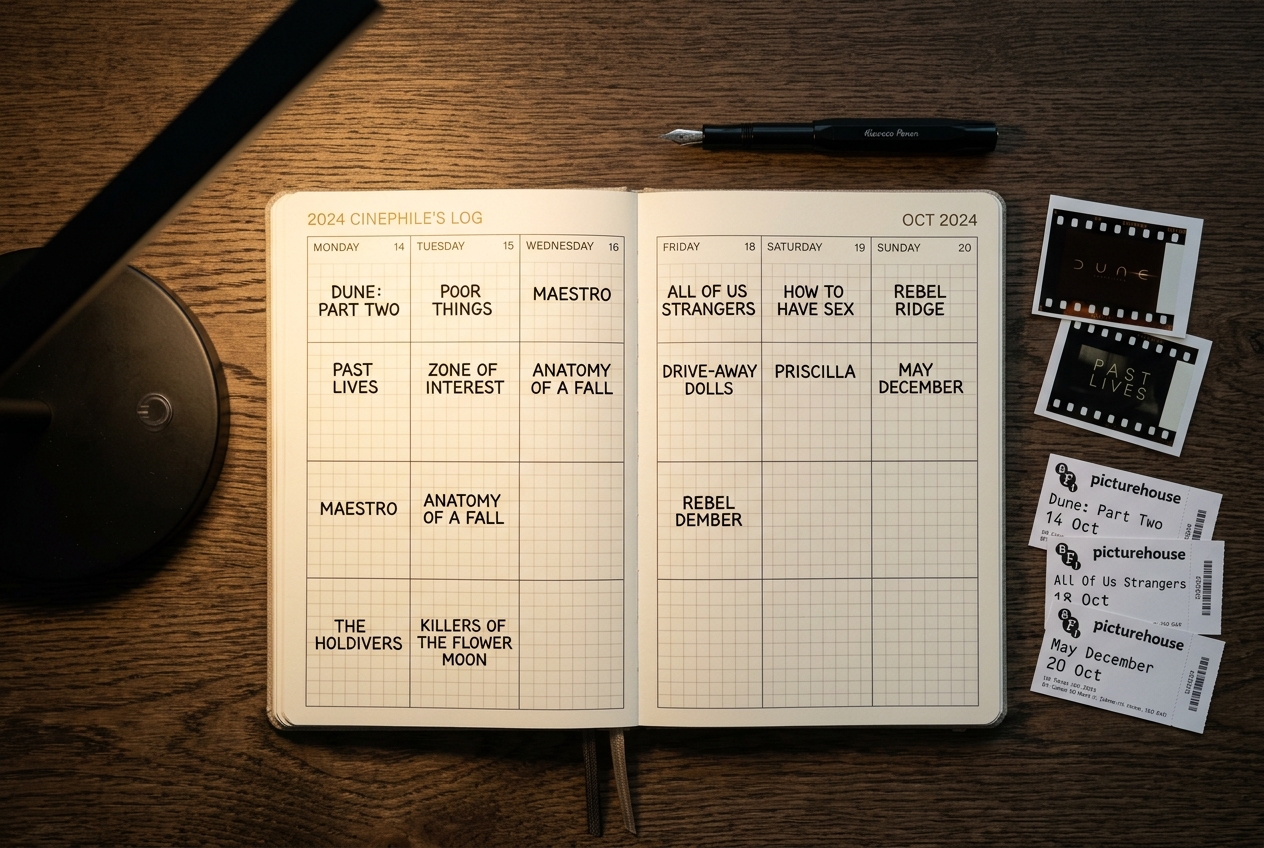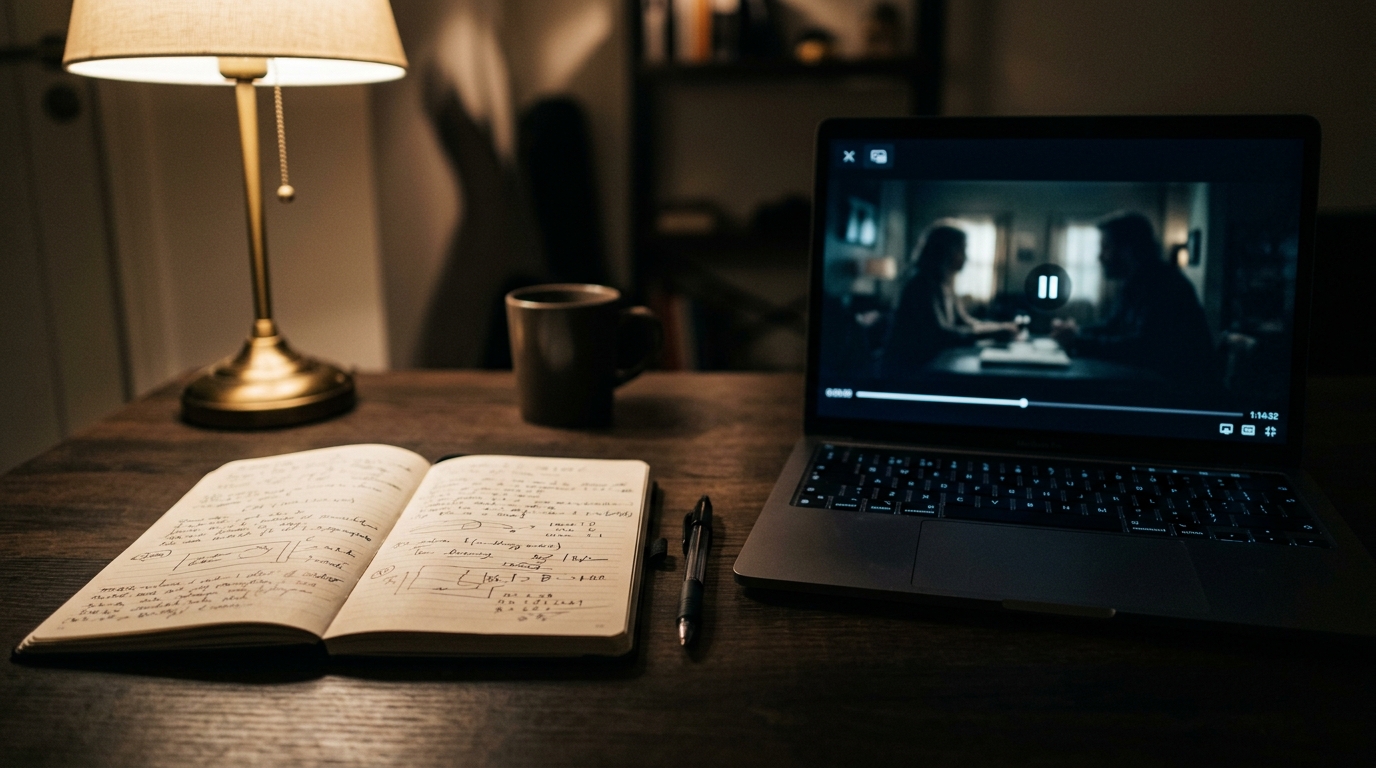
A movie journal is a short written record of what you watched and what it did to you, and keeping one changes how you watch, because knowing you will write something down makes you pay closer attention. A few years ago I watched a film that stayed with me for days. I don't mean I thought about it in passing. I mean I found myself working through specific scenes in idle moments, trying to understand why it landed the way it did. Three weeks later, I couldn't remember the director's name. I remembered fragments: a particular quality of light in a scene, an actor's face at the end of a long take, the feeling of sitting very still when the credits started. But I'd lost the container for all of it, and with it any ability to trace the film back to why it affected me.
That's when I started keeping a journal, which is a different thing from a watchlist system. Not because I wanted to become a film critic or build a public log of every movie I'd ever seen, but because I wanted to stop losing things that had cost me something to find. I've kept one for three years now, and the primary effect isn't the record itself. It's what the act of writing immediately after a film does to how you watch while the film is still running.
Why does keeping a movie journal change how you watch films?
The mechanism is straightforward: when you know you'll write about something, you watch differently. Not better, exactly, and not more analytically in the way of a film student taking notes. More actively. The expectation of articulating a response creates attentiveness that passive viewing doesn't. You start noticing the first shot and what it establishes. You notice the music cue that arrives before something happens. You notice the actor who is almost stealing the film from the lead and isn't quite managing it.
This is different from film criticism, and it's important to keep that distinction clear. Film criticism asks "is this film good?" and applies evaluative frameworks to answer that question. A personal journal asks "what happened to me during this film?" Those are different projects, and conflating them produces the kind of forced, self-conscious journaling that people abandon after two entries because it feels like homework.
The act of articulating even a fragment of what you felt, while the feeling is still fresh and before you've looked at anyone else's take, is qualitatively different from remembering it later. Memory is reconstructive. It edits. It borrows frames from things you've read since and integrates them into what you think you originally thought. The entry you write in the 20 minutes after a film ends is a much cleaner record of your actual immediate response than anything you'd write a week later, and it's the document that becomes genuinely interesting six months down the line.
What are the four format levels for a movie journal?
The format question is where most people stall. They imagine a movie journal as a serious undertaking that requires extended prose for every film, and then don't start because that commitment is too high. The reality is that format should be matched to available time and energy, and the minimal version is far more valuable than people assume.
Format 1: The Minimal Log
Film title, year, date watched, rating out of 10, and one sentence written immediately after the film ends. Not a review, not an assessment of the director's career. A reaction. "This made me feel unexpectedly lonely." "The ending felt false and I can't explain why." "I'd forgotten how funny this was." Total time: three minutes, if that.
The one rule that makes this format work: write the sentence before you look at your phone. Before the algorithm serves you a review, before a friend texts asking what you thought, before any external frame can contaminate the immediate response. Three minutes of capture before you rejoin the world is a small price for having an unfiltered record of what you actually felt.
It pairs well with the 52-film challenge, since one sentence a week is a small tax on 52 films. This format is the right starting point for anyone who hates writing, has limited time, or just wants a log without the editorial overhead. After six months of minimal entries, you have a record that tells you things about yourself you couldn't have seen film by film.
Format 2: The Structured Note
Everything from Format 1, plus three additional slots: one thing that worked, one thing that didn't, and one image or moment you expect to remember. You can also add who you watched it with and in what context, both of which turn out to matter more than most people expect. Total time: 10 to 15 minutes.
The constraint is what makes this format work. You're not trying to write a review or produce a complete account. You're filling in the same three slots every time. The constraint prevents the format from expanding into something unsustainable, and it forces useful precision: you have to identify one specific thing rather than making general impressions, which is a harder and more exacting cognitive task than it sounds.
Format 3: The Response Essay
Not every film warrants this, and treating it as a default would break the habit quickly. Reserve Format 3 for films that demand a longer reckoning: the film you can't stop thinking about, the one that made you angry in a way you want to understand, the one that worked so well you want to trace how it did it. Free-write for 20 to 30 minutes without editing, then trim to the observations that actually matter.
The structure that tends to work: what was the film trying to do, whether it succeeded, what it specifically did to you, and one question it raised that you haven't resolved yet. That last item is often the most valuable. A film that leaves you with an unresolved question is a film that's still working on you, and the question you can't answer usually points toward why the film mattered.
Format 4: The Running Obsession
This is less a format than a practice that emerges from the other three. For directors, actors, or films you return to repeatedly, a journal becomes a record of how your reading changes across multiple viewings. What you noticed on the third watch that you completely missed on the first. What you no longer believe about a film that you were certain of after the first viewing. The scene that seemed like style on the first pass and felt like necessity on the fourth.
This format takes years to develop, and it develops naturally if you keep the journal consistently. It is also how a personal canon starts to form. You don't start with it. It arrives eventually as a byproduct of having kept the others.
What's worth tracking beyond the star rating?
The rating is an anchor, not the point. What surrounds the rating is where the actual information lives. A few fields I've found consistently worth adding:
- Viewing context: alone vs. with others, theater vs. streaming vs. a television in a hotel room, half-asleep vs. fully present. These aren't excuses for a bad rating; they're variables that explain patterns across hundreds of entries.
- Mood going in: this matters more than most people realize. The same film hits differently depending on your emotional state at the start. Logging it lets you eventually see whether you rate films lower when you're tired, or whether certain genres require a specific kind of attention that you sometimes don't have.
- The specific thing that bothered you: not "the ending was bad" but what, precisely, felt wrong. Identifying the specific failure is harder than dismissing the whole, and harder usually means more accurate.
- The scene you'll remember in six months: you almost always know what this is before you write it down. The film has already told you. Trust that instinct and record it specifically rather than letting it dissolve into a general impression of the film.
- The director's previous films you've seen or plan to see: this is most useful in retrospect when you're building a filmmaker's filmography over time rather than watching individual films in isolation.
Six months of entries reveals the gap between the film fan you think you are and the film fan you actually are. Most people are surprised by what they find.
What patterns emerge after six months of notes?
The first thing most people notice is that the directors they keep returning to, in their actual ratings and notes, are not always who they'd claim as their favorites in conversation. There's a gap between stated taste and revealed preference, and the journal makes it visible. I thought of myself as someone who watches a lot of international cinema. My first six months of entries told a more complicated story.
The genre gap is equally common. Many people claim to love horror and consistently rate horror films lower than comedies or dramas. That's not a contradiction: it's information. You may love horror as an idea, as a cultural category, as something you follow enthusiastically in anticipation, but find the actual experience of watching it less satisfying than you expect. Knowing that is genuinely useful when you're deciding what to watch.
Time-of-day patterns emerge surprisingly often. A large number of people rate films watched late at night lower than the same films watched earlier, independent of the film's quality. If your late-night ratings consistently run a point lower than your weekend afternoon ratings, the journal will show you that within a few months. It's a calibration tool as much as a record.
The watched-alone vs. watched-with-others split reveals something different about how social context shapes reception. Some people rate films higher in company because the shared experience amplifies the response. Others find that watching with someone else, particularly someone with different taste, fragments the attention and pulls the rating down. Neither tendency is wrong; knowing yours helps you plan better.
Tracking abandonment is the most underrated pattern of all. The films you turn off before finishing are as informative as the films you rate highly, and most logging systems don't capture them because there's no obvious rating for something you didn't finish. A separate note on what you abandoned and at roughly what point, alongside a brief reason, reveals a lot about the limits of your patience and where your actual taste diverges from your aspirational taste.
Should you use Letterboxd or a private notebook?
Letterboxd offers real advantages if social accountability helps you maintain a habit. The community exists and it's genuinely engaged: you can see how your ratings compare to people with similar taste, discover films through the people you follow, and get the gamified satisfaction of year-end stats and watching milestones. For some people, the public accountability of a Letterboxd account is precisely what keeps them writing entries instead of just watching and forgetting.
A private notebook, whether physical or digital, offers a different kind of value: candor without an audience. Writing for yourself, with no possibility of an external reader, removes the subtle pressure to perform taste rather than simply record it. People are more candid in private about films they found boring, films they turned off 40 minutes in, films they loved for reasons they can't quite defend, and films they disliked but feel they were supposed to enjoy. That candor is harder to sustain when the entry is public.
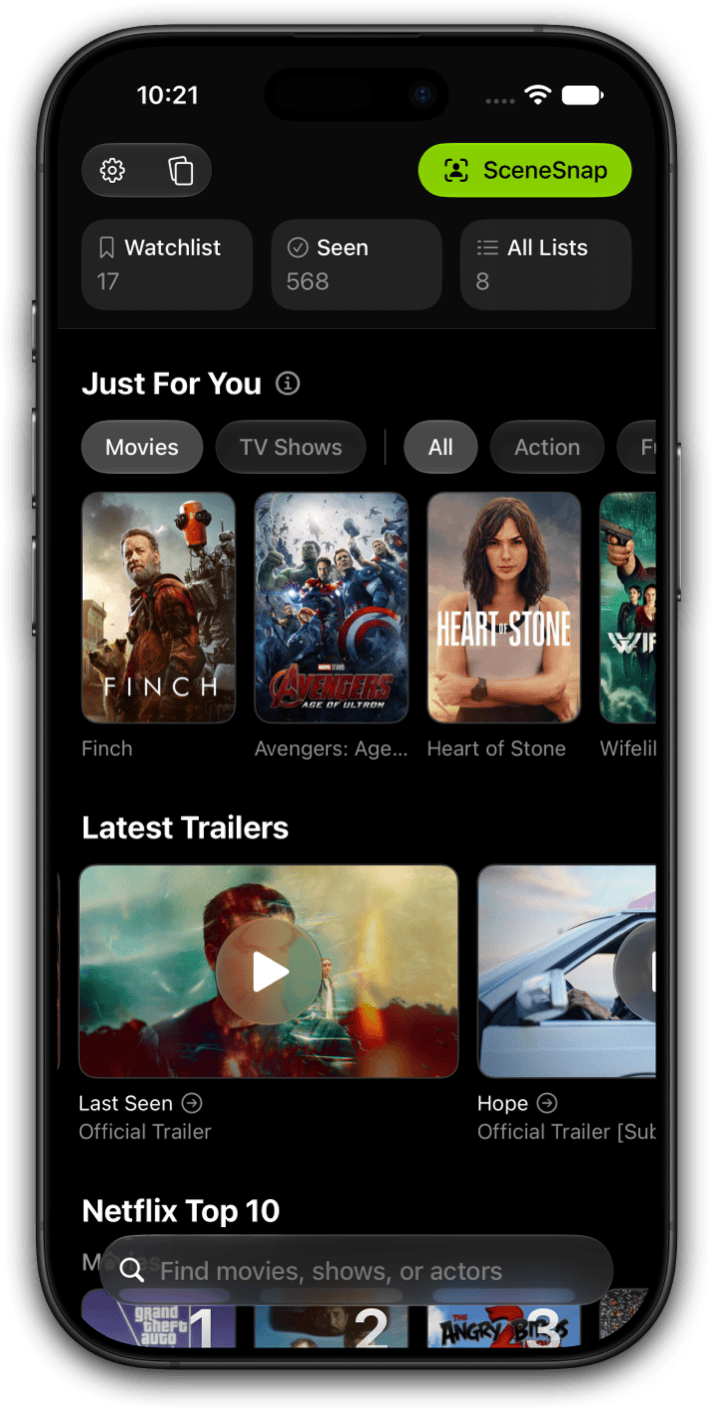
The real question is whether you want to share taste or develop it. Both are valid objectives, and they lead to different formats. Letterboxd is optimized for the former. A private journal is better for the latter. If you want both, the combination that tends to work is a private immediate reaction written right after the film, followed by a more considered entry on Letterboxd if the film warrants it. Limelight's Seen List works well as a lightweight private tracking layer if you want the log without any social dimension at all.
How do you actually start?
Watch something tonight. When it ends, before you check your phone or open another tab, write three sentences. Not a review. Not a rating explanation. Three sentences about what you just experienced. They don't need to be good sentences. They don't need to be insightful. They need to be written before the feeling dissipates.
The first entry is the most awkward because it feels strange to write about something you've just watched without a frame for what kind of writing you're doing. The second entry is easier because you have a precedent. By the fifth, the habit is in place and the question is just which format to use. Start from now, and don't backfill. Trying to retroactively log the last three years of films you've seen is an exercise in discouragement. The log is only useful from the moment you begin it consistently, and consistency starts with tonight.
Track what you've watched in Limelight
Limelight's Seen List keeps your watched history separate from your Watchlist, with ratings and notes on every title.

The value compounds slowly and then becomes obvious all at once. After six months, you have a record that tells you things about your own taste that you couldn't have arrived at through introspection alone. After a year, you have something that functions less like a log and more like a conversation with your past self about what cinema has meant to you, which turns out to be a more interesting document than almost anything else you could have been producing in those three to fifteen minutes after the credits rolled.
Frequently asked questions
No. A rating and a single sentence, written immediately after the film, is enough to build something valuable over time. The goal is a record of your immediate reaction, not a publishable review. Even the minimal log, title, year, date, rating, and one sentence, tells you more six months from now than nothing does.
It depends on whether you want a social or private experience. Letterboxd is the best option if you want community, social accountability, and year-end stats. Limelight's Seen List works well if you want a lightweight private log without the social layer. A physical notebook or a plain notes app works for the purely private formats. The format matters less than the consistency.
As detailed as you'll actually maintain. The minimal log takes three minutes and is sustainable indefinitely. The structured note takes 10 to 15 minutes and works well for most films. The longer response essay should be reserved for films that demand a more extended reckoning. Matching the format to your actual available time and energy is more important than any specific level of detail.
Use whichever scale you'll use consistently. A 10-point scale gives you more granularity, which becomes useful when comparing films after several months of entries. A 5-star scale is faster and less prone to overthinking. The rating is useful primarily as an anchor for your written notes, not as a score in its own right. Either scale works if you apply it consistently.
Letterboxd is a good substitute for some functions of a private journal but not all of them. The social dimension of Letterboxd introduces a subtle pressure toward performing taste rather than simply recording it. Many people are more truthful in a private journal about films they found boring, films they turned off, or films they liked for reasons they can't quite defend. If you want both, keep a private log for immediate raw reactions and use Letterboxd for the longer, more considered entries you'd share.