There's a specific kind of frustration that comes from half-remembering a film. You have one image: a man in a yellow raincoat at the end of a pier at night, or a woman laughing in a diner before everything goes wrong. You know the film exists. You cannot name it. You've tried Googling the details twice, come up empty, and the image is still sitting there in your head weeks later.
This happens more now than it used to. Instagram reels, TikTok clips, screenshots in group chats, frame grabs on Reddit with no caption. Visual content circulates constantly without attribution, and every time you screenshot a frame you can't identify, you're starting a small scavenger hunt with no obvious starting point.
I've been down enough of these rabbit holes to have developed an actual method. What follows is a ranked guide to five approaches, from the one you'll reach for first to the one that handles the job fastest when you have a screenshot. The methods aren't mutually exclusive; running two or three simultaneously covers almost every case.
Does Googling a plot description actually work for identifying films?
For well-known films with distinctive, memorable plot elements, yes. For anything obscure, generic, or visually specific rather than narratively specific, usually not. Google indexes text, not frames, which means its performance depends entirely on whether someone has written about the scene you remember in terms that match what you'd type.
The key to making Google work here is describing the plot beat, not the feeling. "Movie where man realizes he's been dead the whole time" returns useful results. "Sad ghost movie with a twist" does not. "Film where woman discovers she's being filmed through her apartment walls" is searchable in a way that "creepy thriller where someone is watching" simply isn't.
A few things that improve results significantly:
- The approximate decade. Adding "1990s" or "early 2000s" narrows the field dramatically even when you're not certain of the exact year.
- Recognizable actors. Even a vague physical description helps: "I think the lead was a tall dark-haired woman" combined with the plot gives Google more to work with than the plot alone.
- Specific dialogue. Unusual or quotable lines in quotes are often indexed and return direct hits.
- "Film" instead of "movie." This surfaces different results, particularly for international releases, because the coverage uses different terminology.
The ceiling is real: if the scene didn't generate distinctive written coverage somewhere on the indexed web, there's nothing for Google to match. Reverse image search or r/tipofmytongue handles those cases better.
When should you use r/tipofmytongue to identify a forgotten film?
r/tipofmytongue is the most reliable community method for identifying films from verbal descriptions, and its success rate on genuinely obscure titles is higher than most people expect. The subreddit has been active for over a decade and has a contributor base large enough that even very specific queries about films from the 1970s or 1980s get answered within 24 hours more often than not.
The format of your post determines how quickly it gets answered. A post that says "sad movie, 1990s, woman in the rain" gets scrolled past. A post that includes all of the following gets answered:
- Decade (approximate is fine, "I think late 1990s or early 2000s" is useful)
- Country of origin if you have any sense of it ("not American, possibly French or Spanish")
- Genre and emotional tone ("slow drama, not a thriller")
- Specific plot elements, including what happens and in what order
- How you originally encountered it ("I saw it on cable as a kid" or "a friend recommended it in 2015")
- Any visual details: location, period setting, cinematography style, color palette
- The ending, if you remember it, since unusual endings are the fastest search anchors
The more unusual a detail is, the faster the community identifies it. A film where someone does something truly specific, a particular object used in an unusual way, a setting that's rare for the genre, an ending that contradicts the genre's conventions, tends to get answered within an hour. Generic details take longer or don't resolve at all.
Two limitations worth knowing: r/tipofmytongue takes time, and it requires you to describe visually what you remember verbally, which is hard when the memory is primarily a feeling or an image rather than a narrative. For cases where you have an actual screenshot, reverse image search or SceneSnap is faster.
How effective is reverse image search for identifying a movie from a screenshot?
Reverse image search works well when the image has been indexed, which is true for widely circulated stills from major releases and frames that have appeared on film databases, Blu-ray reviews, or editorial coverage. For obscure films or original captures from lesser-known titles, results are more variable. The right tool also matters considerably more than most people realize.
Yandex Image Search is the strongest option for identifying film frames, particularly non-English and Eastern European cinema. Yandex's film recognition outperforms Google Lens on a significant portion of queries, especially anything not American. If you're looking for a foreign-language film or a film from outside the major English-speaking markets, start here rather than Google.
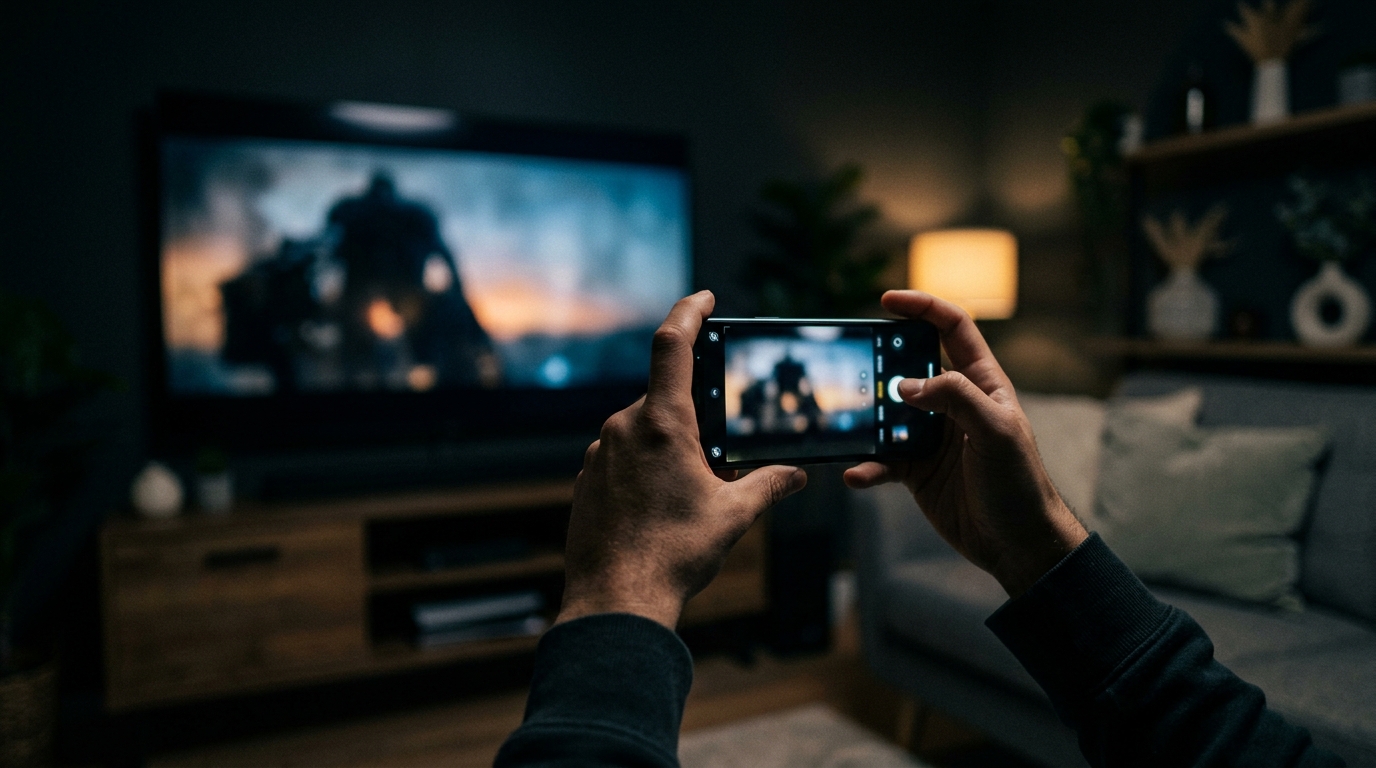
Google Lens (available in the Google app or by right-clicking in Chrome on desktop) handles widely distributed English-language content well. It also works on photos taken directly of a TV or laptop screen, not just digital screenshots, which covers the common case of pointing your phone at a screen to identify something playing.
TinEye searches a different index than Google and occasionally finds matches the others miss, particularly for images that have appeared on photography or film sites. It's worth trying as a third option when the first two don't return results.
One practical detail: when using any of these tools with a photo of a screen, crop out the TV bezel, room lighting, and any interface elements before searching. The search engine is matching visual features of the frame itself, not the furniture around it, and irrelevant pixels reduce match accuracy.
When does IMDb's keyword search outperform everything else?
IMDb's keyword and plot search handles the specific case where you remember plot details clearly but have no image to search and no scene distinctive enough to describe in a way that would work on r/tipofmytongue. It's the best option when the memory is narrative rather than visual.
The advanced search at imdb.com/search/title lets you filter by year range, genre, country of origin, and plot keywords simultaneously. The plot and keyword database draws from years of user-submitted tags covering plot elements, visual motifs, and narrative devices. Searching "plot:woman discovers recording" combined with "genre:thriller" and a year range of 2000 to 2010 narrows a potentially enormous result set to something workable in a way that a plain Google search can't replicate.
One practical tip that saves significant time: sort results by number of votes rather than by relevance. A film with 50,000 votes that matches your keywords is almost certainly the mainstream release you half-remember. A film with 12 votes that shares a keyword is more likely an obscure short that happens to use the same terminology. Relevance sorting surfaces the obscure match first, which is rarely what you want.
IMDb's interface is genuinely not designed for this kind of search, which makes the process tedious. Budget 15 to 30 minutes for a thorough search. If you have a screenshot or a description detailed enough for r/tipofmytongue, those methods will get you there faster. IMDb keyword search earns its place when the other options have failed and the memory is primarily plot-based.
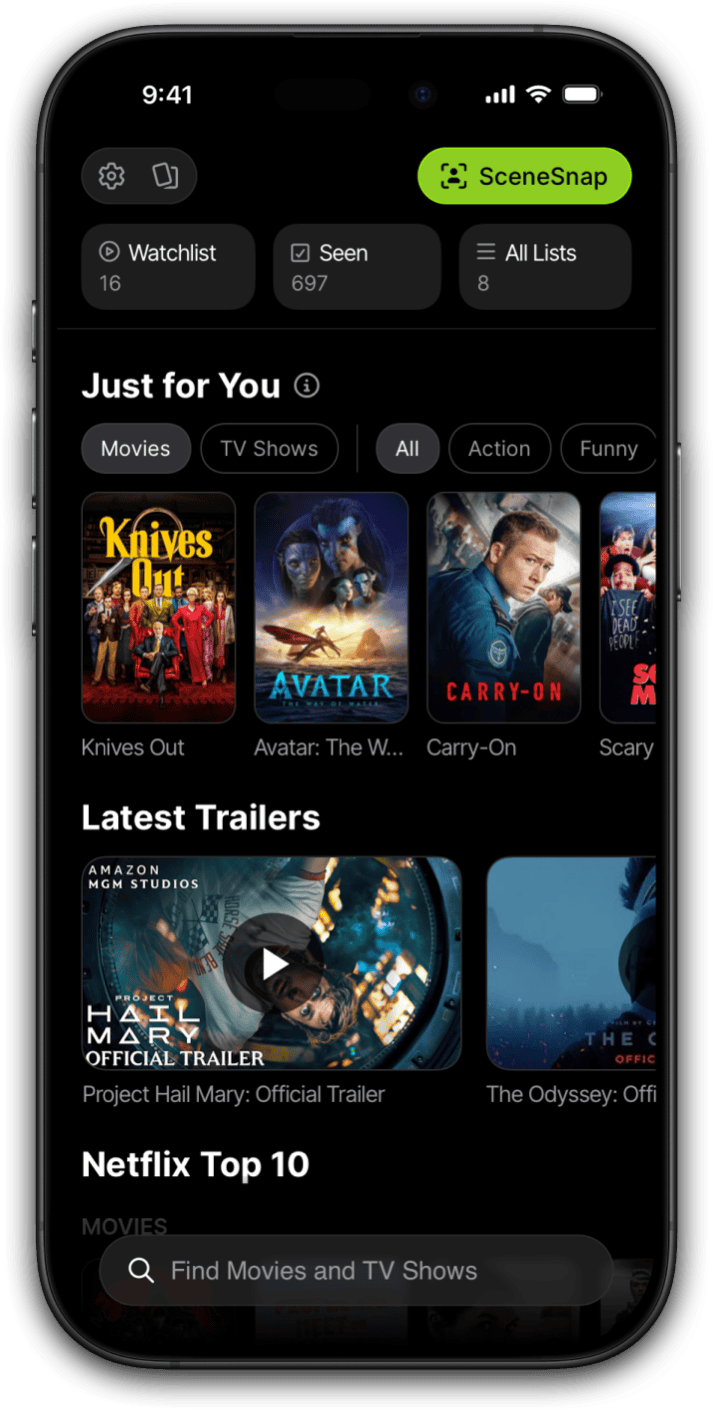
SceneSnap identifies any film from a photo in seconds
Point your camera at a screen, import a screenshot, or describe what you remember. Limelight's SceneSnap returns the title and takes you directly to streaming availability and ratings. Available in Limelight+ on iOS.

How does SceneSnap compare to all the other methods?
SceneSnap is Limelight's AI scene recognition feature, and for the specific use case of "I have a screenshot and I want to know what film it's from," it's the fastest method available. Take a photo or import a screenshot, and it returns the title in a few seconds alongside the full detail page for that film, including ratings from Rotten Tomatoes, IMDb, Metacritic, and TMDB, plus which streaming services currently carry it.
It works from streaming captures, frame grabs from social media, and photos taken directly of a TV or laptop screen. That last case is the one that comes up most often in practice. Someone mentions a film while it's playing across the room. You take a photo. SceneSnap identifies it. The whole thing takes about 15 seconds and puts you on the title page without any additional searching.
The limitations are real and worth being honest about. SceneSnap performs best on films with sufficient visual data in its recognition base: major releases, mid-major releases, and international films with strong streaming or Blu-ray catalogues. Very obscure titles, older limited-release films with minimal digital presence, and some regional cinema don't always match. When SceneSnap doesn't identify a scene, the next step is r/tipofmytongue or IMDb keyword search, depending on whether you have an image or a description to work with.
SceneSnap is a Limelight+ feature at $24.99 a year. For occasional use, Google Lens or r/tipofmytongue covers most cases without a subscription. For people who regularly encounter film stills they can't identify, or who want identification to connect directly to streaming availability and ratings, SceneSnap is meaningfully faster than any combination of the other methods.
How do the five methods compare side by side?
| Method | Best for | Speed | Notes |
|---|---|---|---|
| Google search | Famous scenes, distinctive plot | Seconds | Fails on visually generic or obscure frames |
| r/tipofmytongue | Any film, from a description | 1 to 48 hours | Highest success rate on obscure titles |
| Yandex / Google Lens | Any screenshot or photo | Seconds | Yandex outperforms Google for non-English cinema |
| IMDb keyword search | Plot-based queries, no image | 15 to 30 min | Best when you remember details but not visuals |
| SceneSnap (Limelight+) | Any screenshot or photo | Seconds | Returns title, ratings, and streaming info in one step |
What's the best approach for the hardest cases?
The genuinely difficult cases are ones where the memory is almost entirely emotional: you remember the feeling of the film, or a single visual impression, but no narrative hook you can describe and no image you can search. r/tipofmytongue is the only option that handles these, and they require the most detailed posts you can write. Spend time with the post. Include everything, no matter how tangential it seems. The detail that identifies the film is often not the one you'd expect.
For cases where you have a screenshot from a streaming service with the UI visible, crop the UI out before running any image search. The platform interface is noise that reduces match accuracy, particularly for Yandex, which performs best on clean frame crops.
Running multiple methods simultaneously is always faster than running them sequentially. Post to r/tipofmytongue, run the screenshot through Yandex Image Search, and try a Google plot search at the same time. The three methods together cover almost every case. If all three come up empty, the film is likely very obscure, minimally digitized, or regional in ways that reduce its presence in searchable databases. At that point, a detailed r/tipofmytongue post is the only path forward.
The detail that identifies a film is often not the one you'd expect. Include everything you remember, no matter how small it seems.
I built SceneSnap into Limelight because this problem is genuinely common and the existing solutions all require more steps than the job deserves. The moment when you see a frame and want to know what it's from should take 15 seconds, not 45 minutes of cross-referencing Reddit threads and image search results. Most of the time, it does now. The other methods in this guide are for the cases where the film is obscure enough that the fast path doesn't work, which is a smaller set than you might expect.
Identify any film from a photo, then watch it tonight
SceneSnap returns the title, streaming availability, and ratings in one step. No separate searches, no dead ends. Free to try on iOS, SceneSnap available in Limelight+.
Frequently asked questions
r/tipofmytongue is a Reddit community dedicated to identifying forgotten films, books, songs, games, and TV shows from descriptions. For films with specific plot details, the success rate is genuinely high, especially on releases from the 1980s through 2010s. Posts with detailed descriptions including decade, genre, specific plot beats, and country of origin get answered fastest.
Yes. r/tipofmytongue and IMDb keyword search both work entirely from verbal descriptions. Limelight's SceneSnap also accepts text descriptions as an alternative to photos. Google is the weakest option here unless the plot is highly distinctive and well-documented in writing elsewhere on the web.
Yes, with variable results. Google Lens handles widely indexed English-language films well. Yandex Image Search consistently outperforms Google for non-English cinema. TinEye covers a different index and occasionally finds matches the others miss. All three work on photos taken directly of a TV screen, not just digital screenshots.
All five methods in this guide work for TV shows as well as films. r/tipofmytongue is particularly effective for TV because the community recognizes older shows that image search might miss. SceneSnap identifies TV shows alongside films.
SceneSnap is Limelight's AI scene recognition feature, available in Limelight+. You take a photo or import a screenshot, and it returns the film title in seconds alongside the full detail page including ratings and streaming availability. It works on streaming captures, social media screenshots, and photos taken directly of a TV or laptop screen.